

Custom patches typically cost $1–$10 per unit for most U.S. orders, with the exact price driven by patch type, size, quantity, and any add-ons like specialty materials or rush production. That range covers the vast majority of what designers and small businesses actually order.
Here’s how the numbers break down by order size:
- Small runs (1–24 pieces): $4–$10 per patch, depending on type and size
- Medium runs (25–99 pieces): $2–$6 per patch
- Standard bulk (100–499 pieces): $1–$3 per patch
- Large bulk (500+ pieces): Under $1.50 per patch for many types
Patch type matters just as much as quantity. Embroidered patches sit in the mid-range; PVC and leather/faux options tend to cost more per unit; printed patches can dip below $1 at scale.
Pro Tip: Before you request a quote, know your finished size in inches, your preferred material, and your target quantity. Vendors price faster and more accurately when you give them all three upfront.
Ready to see real numbers? You can get an instant quote or order a sample directly from Octopatches with no minimum order required.
Key Takeaways
Custom patches cost $1–$10 per unit for most U.S. orders, with per-unit price dropping sharply as quantity increases, and no-minimum options making small specialty runs viable without bulk commitments.
| Point | Details |
|---|---|
| Typical per-unit range | Most orders land between $1–$10 per patch depending on type, size, and quantity. |
| Small-run pricing | Expect $4–$10 per patch for orders of 1–24 pieces; medium runs (25–99) drop to $2–$6. |
| Biggest cost driver | Size (priced per square inch) and quantity tier have the largest impact on final unit cost. |
| Best small-run tactic | Order one quantity tier higher than you need to capture the next price break. |
| Octopatches advantage | No minimum order with specialty faux materials and heat-applied application, ideal for small and limited-edition runs. |
Table of Contents
- How much do custom patches cost by type and quantity?
- What actually drives the cost of a custom patch?
- Real quote examples: what will your order actually cost?
- What add-ons and setup fees should you budget for?
- How do turnaround times and shipping affect your total cost?
- Practical ways to lower your total patch cost
- What to gather before you request a quote
- What the pricing data actually tells designers and small brands
- Octopatches makes small-run specialty patches genuinely affordable
- Sources
How much do custom patches cost by type and quantity?
Custom patch prices commonly range roughly $1–$10 per patch depending on size, quantity, and complexity. Most manufacturers calculate price per square inch and apply tiered quantity discounts, so the table below reflects typical U.S. market ranges rather than any single vendor’s sheet.
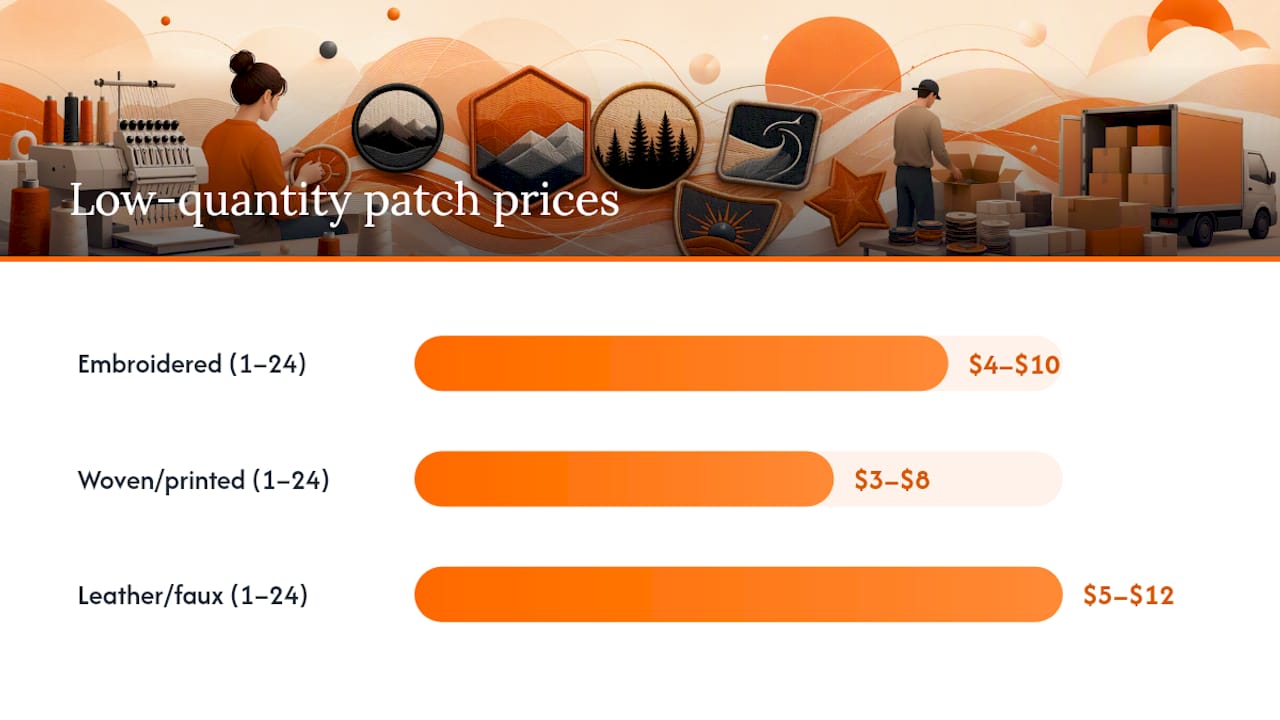
| Patch Type | 1–24 units | 25–99 units | 100–499 units | 500+ units | — |
|---|---|---|---|---|---|
| Embroidered | $4–$10 | $2.50–$6 | $1.50–$3.50 | $1–$2.50 | $0.30–$0.75 |
| Woven / printed | $3–$8 | $2–$5 | $1–$3 | $0.50–$2 | $0.50–$1.50 |
| PVC / rubber | $5–$12 | $3–$7 | $2–$4 | $1–$3 | $1–$2 |
| Leather / faux leather | $5–$12 | $3–$7 | $2–$4.50 | $1.50–$3.50 | $1–$2.50 |
| Heat-applied / specialty faux | $4–$10 | $2.50–$6 | $1.50–$3.50 | $1–$2.50 | $0.30–$0.75 |
A few things worth noting about these ranges:
- MOQs vary widely. Many embroidered and PVC vendors require a minimum of 50–100 pieces. Heat-applied specialty options, like those from Octopatches, carry no minimum order at all, making small runs genuinely viable.
- Printed patches can drop below $1 per piece at large quantities, making them the most affordable option for high-volume, detail-heavy designs.
- PVC and faux leather hold their cost higher across all quantity tiers because of mold and material costs, but they also deliver a premium look that justifies the price for branded merchandise.
Pro Tip: For small runs under 50 pieces, printed or heat-applied faux patches almost always beat embroidered on price. For runs over 250, embroidered patches become competitive and offer a classic, tactile finish that many brands prefer.
What actually drives the cost of a custom patch?
Size is the single biggest lever. Most manufacturers price by the square inch, so a 4-inch patch can cost two to three times more than a 2-inch version of the same design. That relationship is nearly linear until you hit very large sizes, where material costs start to dominate.
Beyond size, here are the primary cost drivers:
- Quantity: The per-unit price drops sharply as you move up quantity tiers. Ordering 100 instead of 50 can cut your per-unit cost by 30–40%.
- Patch type and material: Embroidered patches require digitizing and machine time. PVC needs a mold. Faux leather and specialty materials carry higher raw material costs.
- Stitch count and print detail: For embroidered patches, more stitches mean longer machine time and higher cost. For printed patches, more colors or fine gradients can require additional passes.
- Backing type: Iron-on backing adds a small cost. Velcro (hook-and-loop) adds more. Sew-on is typically the least expensive option.
- Border type: A standard merrowed border is included in most embroidered patch quotes. A laser-cut or die-cut border costs more and is standard for woven and printed styles.
- 3D effects: Adding 3D raised foam under embroidery or using a raised flex material pushes a patch into a higher cost bracket, often adding $0.50–$2 per unit depending on the area covered.
- Artwork preparation: If your file needs vectorizing or color separation, expect a setup fee. More on that in the next section.
A single design decision can move your cost meaningfully. Switching from a standard flat embroidered patch to one with 3D foam on the lettering, for example, can push a $2.50 unit to $4 or more at the same quantity. Choosing a specialty faux material like carbon fiber or denim look instead of standard embroidery gives you a premium texture without necessarily paying for extra stitch time.
Pro Tip: *Simplify large fill areas in your artwork. Solid embroidered fills are stitch-intensive.
Real quote examples: what will your order actually cost?
Worked examples make the ranges concrete. These three scenarios use mid-range per-unit estimates plus typical add-on costs.
Example 1: Small designer run, heat-applied faux leather, 25 pieces
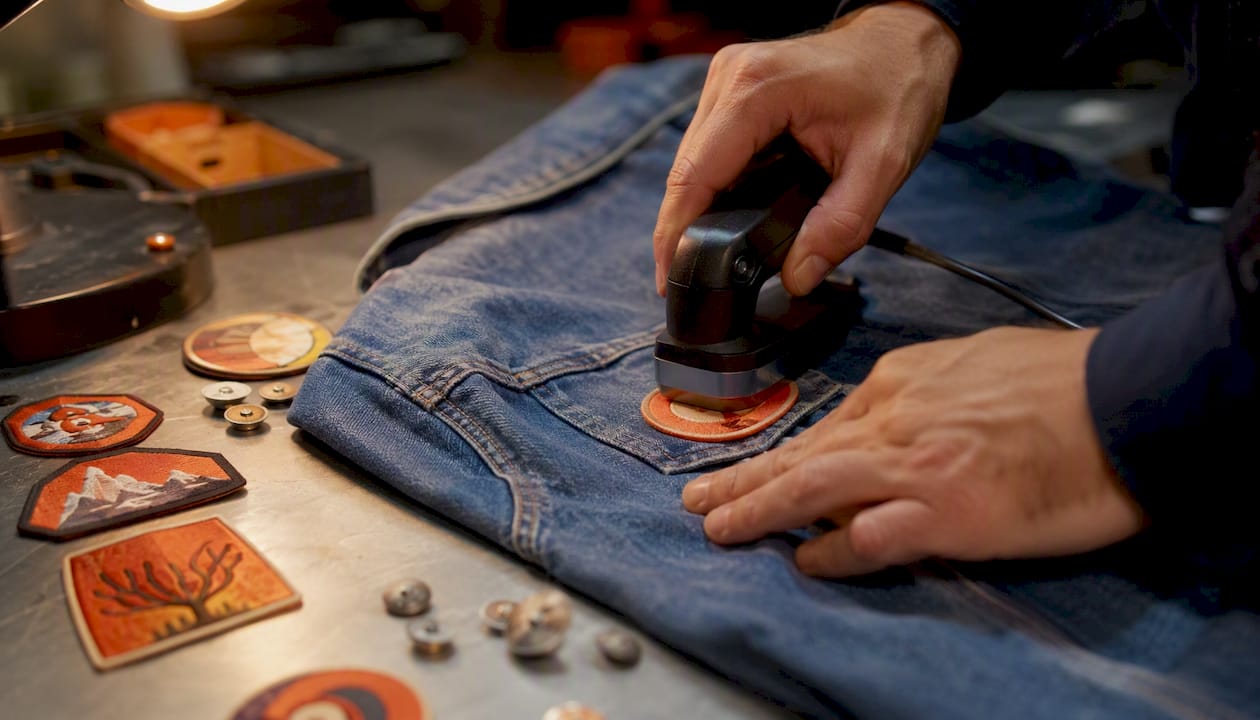
Example 2: Uniform patches, embroidered, 150 pieces
Example 3: Bulk branded merch, woven, 500 pieces
For a designer ordering 50 faux-leather heat-applied patches for a limited-edition apparel drop, Octopatches is a natural fit. There’s no minimum order, the custom patch options include faux leather, denim, carbon fiber, and more, and the heat-applied method means no sewing is required. That combination of specialty texture and zero MOQ is genuinely hard to find elsewhere.
That said, traditional embroidered patches still make sense for certain use cases. If your brand requires the raised, tactile feel of thread-on-thread embroidery, or if you’re ordering 500+ pieces of a single design for uniforms, a traditional embroidered run at scale can deliver a lower per-unit cost with a finish that some buyers specifically request.
Pro Tip: Always ask for pricing at two or three quantity points above your target. The jump from 50 to 100 pieces often saves more per unit than the jump from 100 to 250. Run the math on total spend, not just unit price.
What add-ons and setup fees should you budget for?
The unit price is only part of the story. These are the most common additional charges:
- Digitizing / setup fee: For embroidered patches, converting your artwork into a stitch file (called digitizing) typically costs $15–$50 as a one-time fee. Many vendors waive it at higher quantities or on reorders.
- Professional artwork conversion: If your file is a low-resolution JPEG or needs color separation, you’ll need a vectorized or production-ready file. Octopatches offers a professional design setup service as a paid add-on when standard file cleanup isn’t enough.
- Physical sample / pre-production proof: A physical sample before full production typically costs $15–$40 plus shipping. Some vendors credit the sample cost against your final order.
- Rush sample: Expedited sample production can add $20–$50 on top of the standard sample fee.
- Backing upgrades: Iron-on backing is often standard or a small add-on ($0.10–$0.30/unit). Velcro (hook-and-loop) backing typically adds $0.30–$0.75/unit.
- Packaging and labeling: Individual poly bags, hang tags, or custom labels add $0.05–$0.50 per unit depending on complexity.
On “free artwork” claims: Many vendors advertise free artwork setup, which usually means minor adjustments to a clean, print-ready vector file. If your artwork needs full vectorization, color rebuilding, or significant cleanup, expect a paid setup fee regardless of what the landing page says. When in doubt, ask specifically what “free setup” covers before you submit your file.
On samples: A physical sample is worth the cost on any order over 100 pieces. It lets you verify color accuracy, backing adhesion, and finish quality before committing to the full run. Most vendors do not refund sample costs, but some credit them toward your production order. Sample turnaround is typically 5–10 business days; rush samples can arrive in 2–3 days for an added fee.
How do turnaround times and shipping affect your total cost?
Standard production lead times vary by patch type:
- Embroidered patches: 10–15 business days after artwork approval
- Woven / printed patches: 7–12 business days
- PVC / rubber patches: 14–21 business days (mold production adds time)
- Heat-applied faux patches: 5–10 business days for most orders
Some vendors charge a flat rush fee ($30–$75); others apply a percentage surcharge.
Shipping adds real cost, especially on small runs. Domestic USPS or parcel shipping for a small order of 25–50 patches typically runs $8–$20. Large bulk orders (500+ pieces) may ship via freight, which can add $40–$100 but drops the per-unit shipping cost significantly. For international orders, customs duties and import fees apply on top of shipping and vary by destination country.
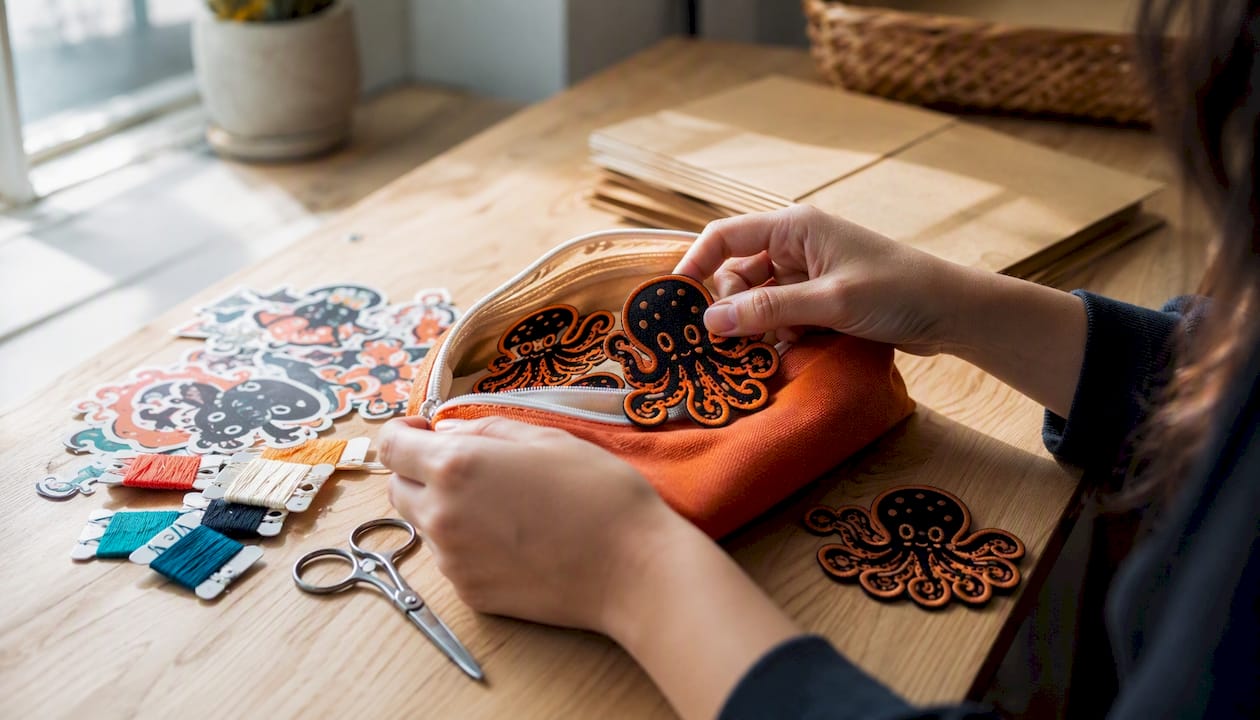
Pro Tip: Order your sample at least three weeks before your production deadline. That buffer lets you review the sample, request any adjustments, and still hit standard production lead times without paying rush fees. Check the application instructions for heat-applied patches before your sample arrives so you can test immediately.
Practical ways to lower your total patch cost
Small choices add up fast. Here are the tactics that actually move the number:
- Step up one quantity tier. If you need 80 patches, pricing at 100 often costs less per unit than 80. Run the math on total spend.
- Simplify your artwork. Fewer colors, cleaner lines, and less fine detail reduce stitch count for embroidered patches and print complexity for woven or DTF styles.
- Choose printed or woven for intricate, small designs. A 1.5-inch patch with fine text or gradients will look sharper and cost less as a woven or printed patch than as an embroidered one.
- Pick sew-on backing when application method allows. It’s the least expensive backing option and works fine for patches that will be permanently sewn onto garments.
- Use gang sheets for printed patches. Placing multiple designs on a single large sheet and cutting them apart afterward reduces per-piece cost. Some bulk print providers structure their pricing entirely around gang-sheet runs.
- Consider material durability in your cost math. A heat-applied faux leather patch at $4.50 per unit that lasts through 50+ wash cycles can be more cost-effective long-term than a cheaper printed patch that fades after 10 washes.
Pro Tip: Order a sample pack before committing to a full run. Octopatches offers an OctoPatch sample pack so you can feel the materials, test the heat application, and confirm the finish before placing your production order. Catching a material mismatch at the sample stage costs far less than reprinting 200 patches.
What to gather before you request a quote
Getting an accurate quote fast comes down to having your specs ready. Work through this checklist before you contact any vendor:
- Final artwork file — vector format (AI, EPS, or high-resolution PDF) preferred; include a reference image if the file needs cleanup
- Finished size — width and height in inches; if the shape is irregular, note the longest dimension
- Preferred patch type — embroidered, woven, printed, PVC, heat-applied faux, or other
- Backing type — sew-on, iron-on, Velcro, or heat-applied
- Quantity — your target number, plus two higher tiers (e.g., 50 / 100 / 250) so you can compare price breaks
- Color requirements — Pantone or thread color codes if brand accuracy matters; note whether gradients or photographic detail are involved
- Required turnaround — your hard deadline and whether rush production is acceptable at added cost
- Shipping destination — city, state, and ZIP; note if international shipping or customs documentation is needed
Questions to ask every vendor before you commit:
- What is your minimum order quantity, and does it apply per design or per order?
- What does your sample policy cover, and is the sample cost credited toward production?
- How long does a proof or digital mockup take, and is it included?
- What setup or digitizing fees apply to my specific file?
Always request price breaks at multiple quantity points. The difference between 50 and 100 pieces is often larger than you’d expect, and knowing that number upfront lets you make a smarter inventory decision.
What the pricing data actually tells designers and small brands
The numbers in this guide point to something most patch pricing articles skip: the real cost trap for small brands isn’t the unit price. It’s the MOQ. A vendor quoting $1.50 per patch sounds great until you realize the minimum is 500 pieces, which means $750 before setup and shipping. For a designer testing a new design or a small brand launching a limited run, that’s a lot of inventory risk for a product you haven’t validated yet.
The smarter move for most small-run situations is to pay a higher per-unit price on a smaller quantity, prove the design sells or fits the application, and then scale into bulk pricing once you have real demand. Heat-applied faux materials are particularly well-suited to this approach because they don’t require sewing equipment on the customer’s end, which removes a barrier for apparel decorators and small brands working with contract manufacturers.
For uniform patches or large-scale branded merchandise where the design is locked and the quantity is certain, traditional embroidered patches at 250+ pieces remain a strong choice on both cost and durability grounds.
One more thing worth pricing into your SKUs: if you’re reselling patches or building them into a product price, add setup fees and shipping to your unit cost before calculating margin. A patch that costs $2.25 per unit often lands closer to $3.00–$3.50 fully loaded once you account for setup, shipping, and a small buffer for rejects or replacements.
Octopatches makes small-run specialty patches genuinely affordable
No minimums. That’s the sharpest contrast Octopatches offers compared to most patch vendors, and for designers and small brands, it changes the math entirely. You can order one patch or one hundred, in faux leather, denim, carbon fiber, wood look, canvas, camo, and more, without committing to a bulk run you might not need.
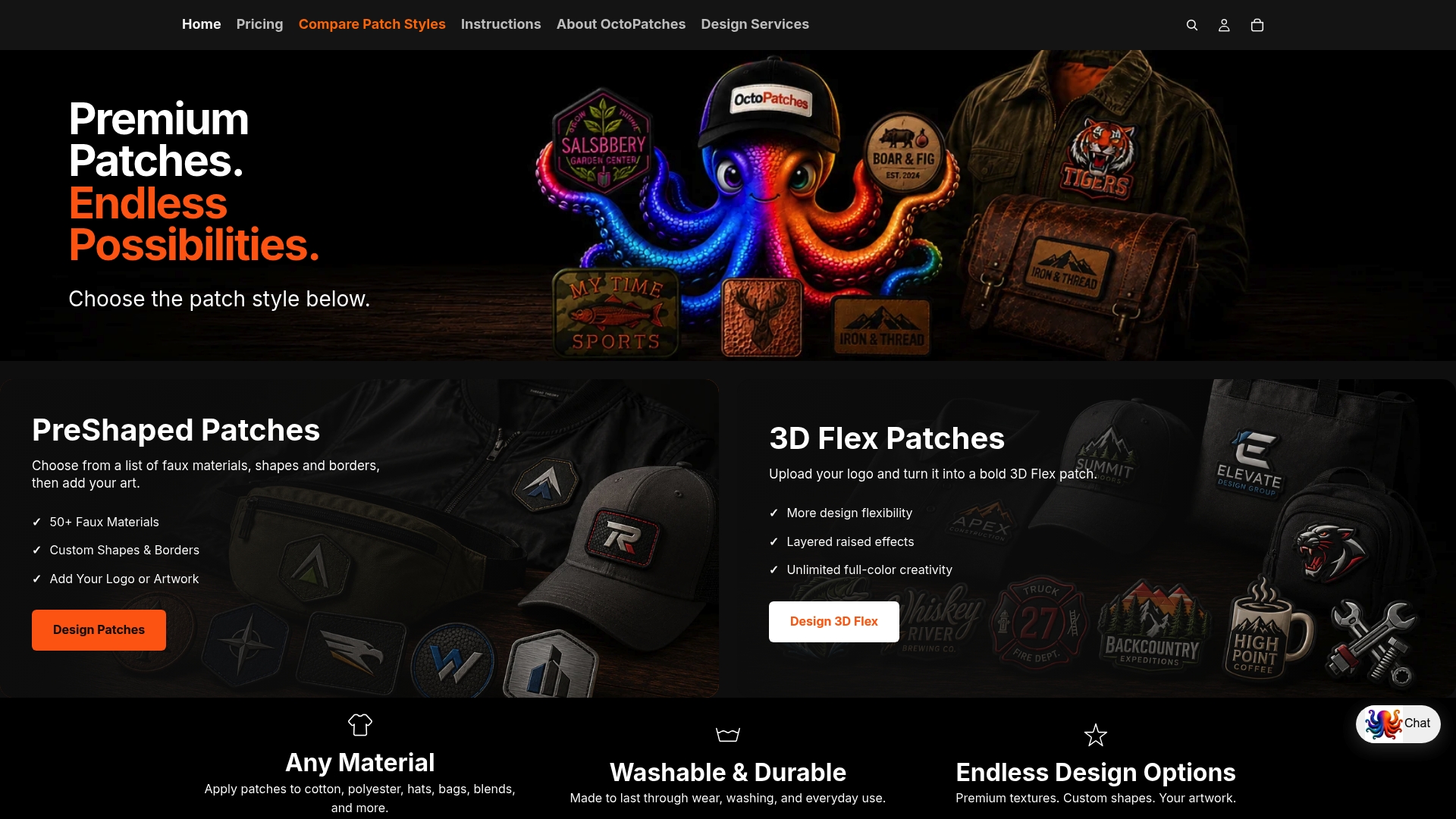
The heat-applied custom patches from Octopatches bond directly to fabric with a heat press or similar tool, no sewing required. They’re durable, washable, and available in custom shapes and borders, with optional 3D raised effects. If your artwork needs professional prep, the design setup service handles vectorization and file conversion so your patch goes into production ready. Not sure which faux material fits your project? The compare patch styles page walks through textures and recommended applications side by side.
Start with a sample pack to test the material and application, then place your production order with confidence.
Sources
- How to Calculate Custom Patch Pricing? Complete Guide - Aqua Digitizing
Before finalizing any order, request a written, line-item quote from your vendor that breaks out unit cost, setup fees, backing add-ons, and shipping separately. A single bundled price makes it impossible to compare vendors or identify where you can save.